Article • 1 min read
Customer service quality assurance: The ultimate guide
Customer service quality assurance helps you deliver consistently high-quality service across every channel. Learn all about the QA process in our guide.


Kevin Boyer
Sr Director, Product Marketing
Última actualización en March 11, 2026


Restaurants don’t attain Michelin-star status by just checking food as it leaves the kitchen. The real improvement happens after the dinner rush, when the head chef and restaurant manager review the shift. They read every comment card and guest complaint. They assess the success of the evening and investigate patterns, like two different tables sending the same dish back. This retrospective review is the restaurant’s QA.
By analyzing these guest experiences, they don’t just fix one bad dish. They identify root causes, update their training manuals, coach the staff, and refine the entire service model. This is how they assure a consistent, star-worthy experience for all future guests—and you can apply this same method to your customer service.
Customer service quality assurance is a strategy that evaluates customer support interactions and identifies where you can improve to provide five-star service. In this guide, we touch on why QA is so important, how you can establish it in your organization, and how it relates to the customer experience (CX).
What is quality assurance in customer service?
Customer service quality assurance (QA) is a systematic process of evaluating customer interactions, identifying areas for improvement, and providing effective coaching to enhance the overall customer experience. A strong customer service QA program maintains consistent service quality across agents and channels by monitoring interactions, scoring performance, and providing feedback.
More in this guide:
- Why is quality assurance important in customer service?
- Benefits of quality assurance in customer service
- How do you measure quality assurance in customer service?
- 9 steps to establish customer service quality assurance in your organization
- Frequently asked questions
- Achieve your customer service QA goals with Zendesk
Why is quality assurance an important part of customer service?
The importance of quality assurance in customer service relies on the fact that organizations can use it to ensure their support teams provide consistent, high-quality service that exceeds customer expectations.
Customers want outstanding experiences whenever they connect with your business—and the right QA processes can help you deliver. According to the Zendesk QA Customer Service Quality Benchmark Report:
86% of surveyed organizations agree QA processes like conversation reviews improve the quality of customer service.
- 76% of surveyed organizations agree that QA helps to improve customer satisfaction (CSAT).
You can use quality assurance to improve the CX, create personalized interactions, and turn simple customer transactions into relationships.
Benefits of quality assurance in customer service
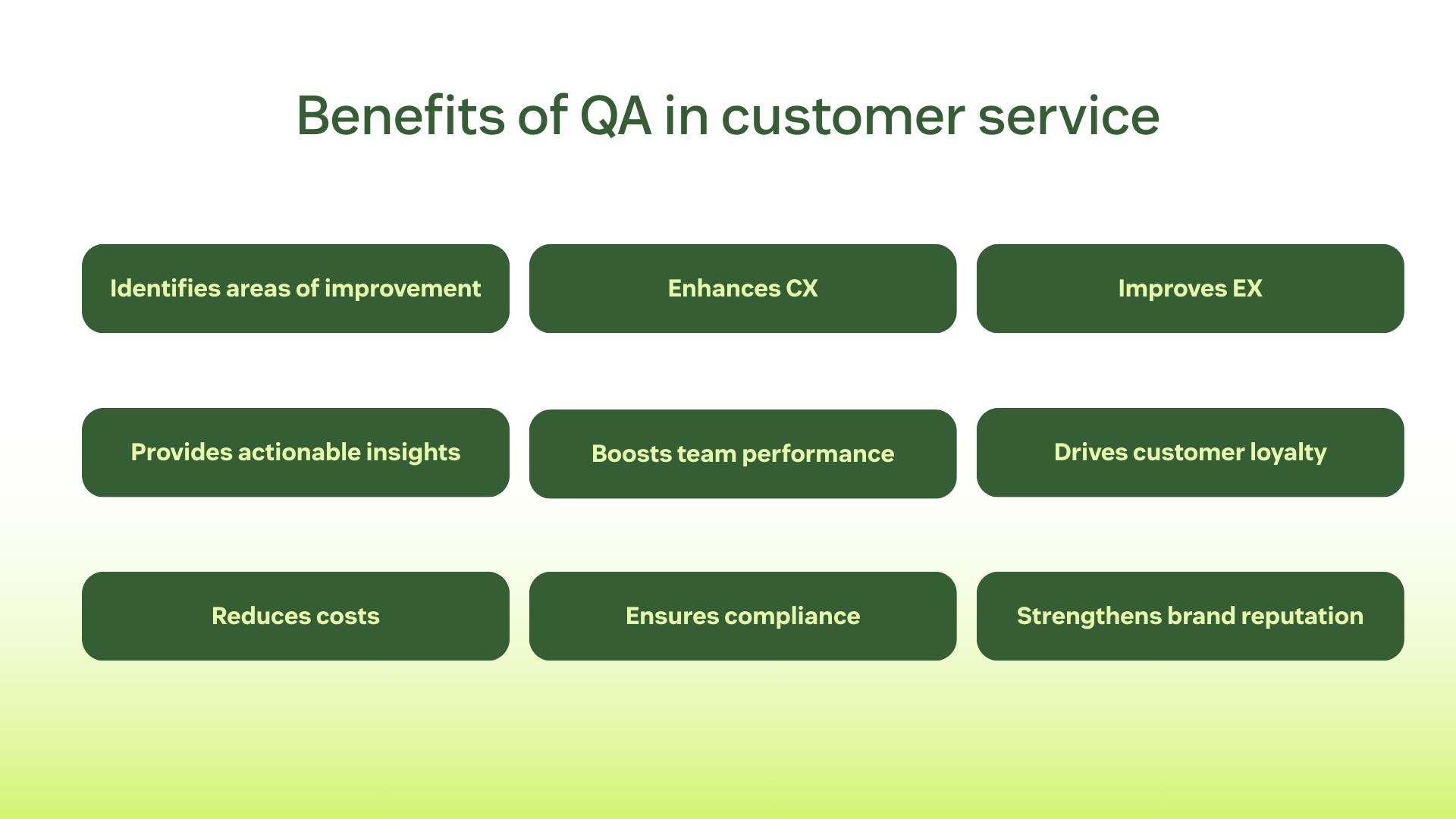
Customer service QA provides a wealth of benefits that can impact nearly every aspect of your organization, including call centers, contact centers, and BPOs. Here are some of the most impactful advantages of quality assurance.
Identifies areas of improvement
Arguably the most important benefit of customer care quality assurance is identifying areas of improvement. With an effective QA process, you can highlight your team’s performance trends, identify root causes of inefficiencies, and implement corrective processes.
It’s important to rely on robust QA platforms that give you complete visibility into customer conversations, enabling you to review all customer interactions. You can also use quality assurance alongside your customer service key performance indicators (KPIs) to facilitate more impactful data-driven decision-making.
Provides actionable insights for agents
QA for customer service delivers data-backed insights drawn directly from customer interactions. When a customer selects “not satisfied” in a post-call survey and your CSAT drops, you know something went wrong, but you don’t know why. QA reveals the root cause.
By reviewing the interaction, you can determine whether the agent lacked product knowledge or failed to follow a process. These insights can only be uncovered through careful analysis of the conversation itself.
With this clarity, managers can take targeted action like scheduling coaching sessions to address knowledge gaps. This action on the root cause ensures issues are solved at their source, improving performance over time.
Reduces cost
Quality assurance in customer service helps improve operational efficiency, which reduces cost. QA reviews interactions to find root causes of issues or training gaps that slow teams down.
For instance, discovering that many agents fail process adherence reveals that the problem is likely the process, not the agents. With this information, you can apply the necessary fixes to reduce rework, escalations, and consequently, the overall support costs.
QA also flags signs of churn risk or unhappy customers by revealing recurring complaints or negative sentiment. Catching these patterns early helps teams prevent bigger, more expensive problems. In short, QA identifies the gaps in service that, once resolved, lead to smoother operations and more cost-effective support.
Enhances the customer experience
Quality assurance in customer service can help you evaluate the state of your support interactions. By consistently monitoring the quality of these interactions, you can identify pain points, inefficiencies, and roadblocks in the customer experience.
For example, maybe your agents are unknowingly ending conversations incorrectly—perhaps they’re not asking if there’s anything else they can do for the customer. You can provide a better CX and deliver good customer service by identifying and correcting these sub-par interactions.
Boosts team performance with coaching and AI improvements
During QA, managers can review customer interactions to identify underperforming agents, knowledge gaps, and issues related to customer service skills that need attention.
They can use this information to provide targeted feedback, schedule regular coaching sessions, and track how coaching impacts key metrics like CSAT and internal quality score (IQS). This tracking is essential to improve performance, resulting in higher morale and greater accountability across teams.
Tracking interactions also helps to refine AI instructions. Every reviewed interaction becomes an opportunity to improve automated responses and close feedback loops that enhance human and AI performance.
With continuous interactions analysis, coaching, and AI improvements, QA fosters ongoing enhancements in service quality, efficiency, and customer satisfaction.
Ensures compliance
Managing customer data requires strict adherence to privacy and security guidelines. Customer service QA is important for monitoring interactions to make sure agents comply with company policies and legal regulations.
This is especially important in industries like finance and healthcare, which deal with highly sensitive data. Acting proactively to keep up with such important compliances minimizes the risk of costly fines, legal exposure, and reputational damage.
Improves the employee experience
An efficient quality assurance process can directly contribute to the employee experience (EX). You can use QA to speed up new hire onboarding, and provide ongoing coaching and training. Doing so shows your team that you are invested in their development, which can result in improved job satisfaction and lower employee turnover.
Drives customer loyalty
Customer loyalty, or how likely consumers are to make repeat purchases with your company, is directly linked to the customer experience. Customer experience quality assurance can help you understand what’s lacking in your CX, identify and rectify problematic agent activities, and build an effective support system. This can boost customer retention, reduce churn rate, and build long-term customer relationships.
Strengthens brand reputation
Customer service QA ensures customers receive reliable and high-quality support. When customers know they can count on your support regardless of the channel or agent, trust in your brand grows.
Here’s how QA enhances brand reputation:
It helps deliver consistent customer experiences by setting standards for tone, accuracy, and resolution.
It reduces errors and escalations by identifying issues early.
It prevents friction points by surfacing recurring problems, so you can act proactively.
It improves CSAT and loyalty by enhancing the overall customer experience.
QA builds trust and prevents negative experiences that could harm your brand. In turn, higher satisfaction and smoother interactions lead to a more positive brand reputation.
How do you measure quality assurance in customer service?

Depending on your organizational structure and business needs, you can measure quality assurance in customer service a few different ways. Here are some examples.
- QA software: Modern quality assurance software uses AI to improve the customer experience. Tools like Zendesk QA use AI in customer service quality assurance to automatically evaluate conversations, detect risks and critical insights, highlight areas for improvement, and more.
- KPIs: Identify and monitor important KPIs, like internal quality score (IQS), customer satisfaction score (CSAT), and first contact resolution (FRT), to evaluate how effective your support interactions are and how well process changes were implemented.
- QA scorecards: QA scorecards are used to grade support agents on various categories, such as introduction, tone, and resolutions. You can use scorecards across all channels: voice calls, email support, messaging, and any other form of customer service communication.
- Customer surveys: When in doubt, ask your customers directly. Request customer feedback through a method like Net Promoter Score (NPS) for better insight on how customers gauge your support.
- Employee surveys: It’s also important to understand what your customer service team is thinking. Conduct employee satisfaction surveys to identify how they feel about their role and their perspective on your support strategy.
You don’t need to implement every method included above, but combining a few of them is a good idea to get a well-rounded view of your QA for customer service efforts.

9 steps to establish customer service quality assurance in your organization
Now that we’ve covered how important customer support quality assurance is, we’ll dive into some ways you can incorporate it into your organization. Here are 9 steps to follow.
1. Define your support vision and quality goals
Before making any progress in your QA process, you’ll want to clearly define what “quality” means to your team. Take time to assess your current operations. Identify your ideal support vision, what’s important to your customers, and your future goals.
Some organizations may take a cost-focused approach and want to improve agent efficiency to lower labor costs. Others may take a customer-focused approach and want to prioritize improving a related metric like Customer Effort Score (CES).
Whatever your focus is, you’ll create a more effective strategy by aligning your support vision and goals.
2. Pick rating categories for your QA scorecards
When developing your QA scorecards, it’s important to select the rating categories that align with your vision and goals. For example, if you want to improve agent comprehension and resolution rates, you should choose grading categories for that part of the interaction. In Zendesk QA, users can start with out-of-the-box categories and also create their own, to measure exactly what they deem important.
3. Use tools like Zendesk QA to automatically score all your conversations
Any size business can experience hundreds of customer interactions per week, but it’s inefficient to manually review every single one. Instead, choose the most important variables to focus on and prioritize conversations with those attributes. QA software with AI and automation features can help with this.
For example, if product knowledge, identification of customer needs, and solution effectiveness are most important for you, AI can automatically scan all conversations for these variables and highlight problematic interactions. This empowers managers to review the right conversations and identify bad customer service without wasting time sifting through everything.
4. Analyze conversations for root causes
Agents’ failures aren’t the only factors that impact customer service. The quality of your service may also be impacted by workflow gaps, unclear policies, lack of training, or even product issues.
Analyzing conversations for root causes helps you spot these systemic issues beyond individual agent behaviors. For example, if you find out that multiple agents are failing the ‘knowledge’ section, the problem is probably rooted in a knowledge base gap.
To analyze data for root causes, combine quality scores with metrics like CSAT, resolution time, and escalations. This helps spotting patterns across teams, ticket types, or workflows.
Additionally, look for recurring mistakes, dips tied to product changes, or processes that consistently slow agents down. With clear root causes well defined, you can design targeted fixes to enhance customer service quality.
5. Set up assignments for regular reviews
A consistent QA process needs to have a clear review system. Your team needs to know who reviews what and how often. So, you should assign QA analysts, team leads, or managers to regularly evaluate interactions. Regular assignments help you catch issues early, ensure every team member receives consistent feedback, and keep your coaching strategies updated.
6. Plan calibration sessions
It’s likely that multiple individuals will complete QA reviews of your support agents. Therefore, businesses need to ensure that every quality reviewer follows the same criteria and rating system—and that’s where calibration sessions come in.
Calibration sessions are guidelines for reviewers, promoting consistency and ensuring every manager grades support agents on the same criteria. During these sessions, revisit your QA score card categories, rating scale, general approach, and more to ensure balanced reviews.
7. Measure customer service quality over time
Once you have a QA system in place, consistently measure customer service quality to ensure your process is effective. Monitor your KPIs like CSAT and customer survey results. Note your performance and review support conversations and QA scorecards to see if you’re trending up or down. By regularly measuring your service quality, you can identify areas of improvement in your process and optimize your customer service training.
8. Deliver coaching & feedback
One of the main points of establishing a QA process is to be able to provide constant coaching and feedback. QA ensures agents receive timely and consistent guidance that’s rooted in real interaction insights.
Carry out coaching sessions regularly, where you provide feedback and guidance on how to apply it. Make sure to also have routine 1:1s between managers and agents, as they’re crucial for developing individual goals.
Additionally, coaching sessions are especially valuable during onboarding. Managers can pin and save conversation examples, build action plans, and help new agents level up faster. When coaching is continuous and insights-based, it strengthens agent performance and reinforces a culture of ongoing improvement.
9. Close the feedback loop
Data can only tell you so much—it’s what you do with that data that separates good QA from great QA. More than just incorporating customer feedback, you need to create action points to implement learnings and feedback.
Use customer feedback or category scores to implement targeted coaching sessions and training to improve your processes and team. Update training sessions, fix broken product knowledge articles, and simplify complicated internal processes. Doing so makes the improvements extend beyond individual agents.
Consistently turning QA insights into learning opportunities helps you create a continuous improvement cycle. When you close the feedback loop and support your employees with additional training, you can improve your QA processes, strengthen service quality, and better support your team.
Frequently asked questions
Achieve your customer service QA goals with Zendesk
Customer service quality assurance can turn your organization from an inefficient operation to a five-star establishment. That said, you need the right tools and methods to measure QA and monitor it daily. That’s where we can help.
Zendesk provides AI-powered customer service quality management tools. With Zendesk QA, Zendesk customers can implement high-quality CX and QA strategies that drive customer loyalty and improve agent retention.
Try it for free today.
Net Promoter, Net Promoter Score, and NPS are registered trademarks of Satmetrix Systems, Inc., Bain & Company, Inc., and Fred Reichheld.

.jpg)