Vicepresidente de Marketing de Productos, IA y Automatización
Última actualización en 20 de abril de 2026
¿Cuál es la diferencia entre deep learning y machine learning?
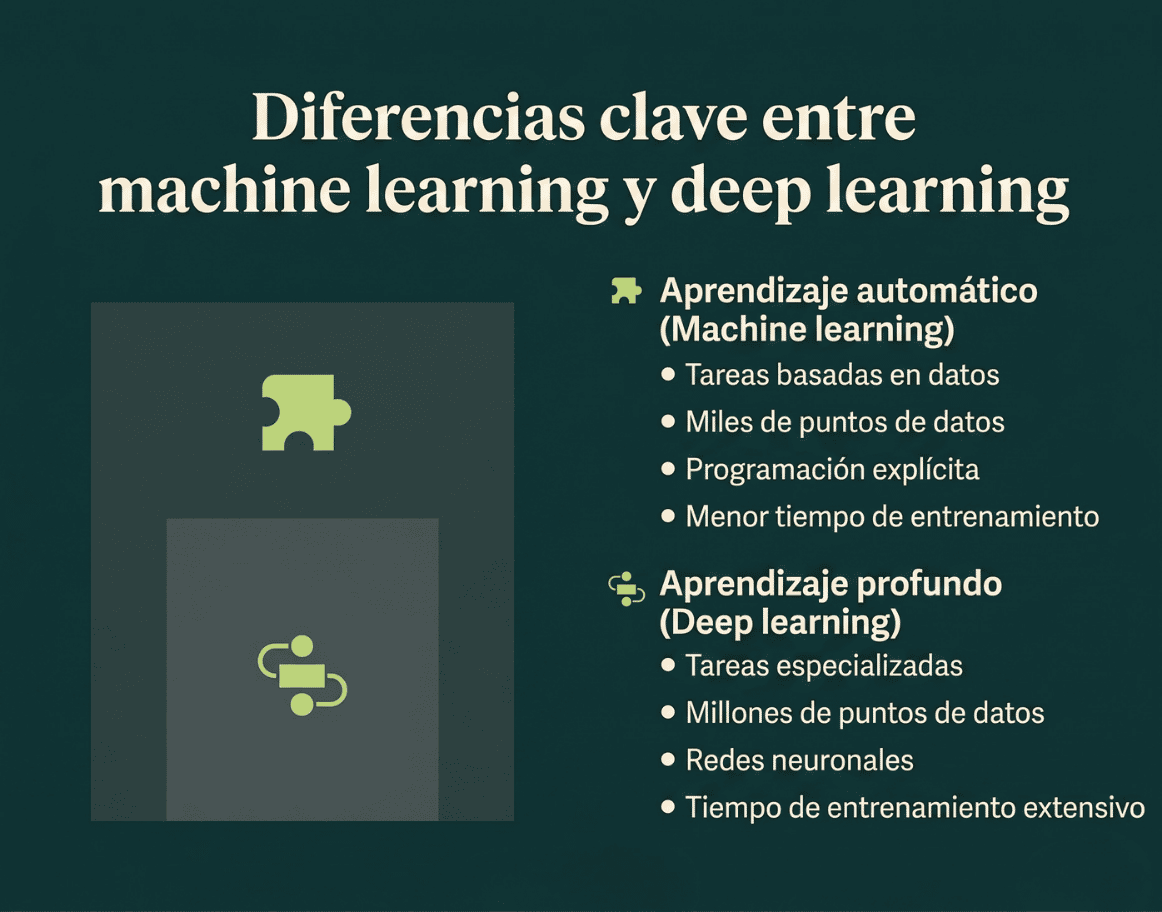
El deep learning (DL) es una evolución del machine learning (ML). Ambos son algoritmos que usan datos para aprender, pero la diferencia clave es cómo los procesan y aprenden de ellos. Por ejemplo:
Los modelos de machine learning necesitan intervención humana para aprender de comportamientos y datos.
Los modelos de deep learning usan redes neuronales para ajustar comportamientos y hacer predicciones.
De hecho, un modelo de deep learning es capaz de aprender a través de su propio método de computación—una técnica que hace que parezca que tiene su propio cerebro.
El machine learning y el deep learning empujan los límites de la innovación al impulsar herramientas con inteligencia artificial (IA). Desde agentes de IA completamente autónomos y autos que se conducen solos hasta feeds de usuarios curados y recomendaciones personalizadas de Netflix, el ML y el DL están en todas partes.
A medida que el machine learning y el deep learning surgen, los consumidores lo están notando. Según nuestro Reporte Zendesk CX Trends 2026, el 70 por ciento de los clientes ve una brecha clara entre las empresas que aprovechan la IA efectivamente y las que no. Y aunque el ML y el DL trabajan juntos, es importante entender las diferencias entre deep learning vs. machine learning para satisfacer las necesidades de los clientes y expectativas.
En nuestra guía, descubrirás por qué el ML y el DL dominan las conversaciones sobre IA y ejemplos exitosos de cada uno.
Deep learning vs. machine learning vs. inteligencia artificial
El DL y el ML son algoritmos de IA que simulan la inteligencia humana. Junto con la IA, estas tecnologías impulsan herramientas y programas impulsados por IA. A continuación, cubrimos las diferencias entre deep learning vs. machine learning vs. inteligencia artificial.
Inteligencia artificial vs. machine learning vs. deep learning
IA
ML
DL
Uso
Un amplio espectro de simulación de inteligencia
Tareas específicas basadas en datos y predicciones
Tareas especializadas que requieren reconocimiento de patrones
Intervención humana
Varía desde completamente autónomo hasta supervisión significativa
Requiere ingeniería regular y ajuste de modelos
Mínima una vez entrenado
Datos
Puede requerir múltiples tipos de datos y fuentes
Puede funcionar con conjuntos de datos de tamaño moderado
Requiere un conjunto de datos masivo
Entrenamiento
Varía por sistema
Entrenamiento computacional estándar
Intensivo en tiempo y extensivo
Ingeniería
Requiere conocimiento amplio en múltiples dominios
Conocimiento estadístico y algoritmos establecidos
Arquitectura de redes neuronales
¿Qué es la inteligencia artificial?
La IA se refiere a máquinas que imitan la inteligencia e interacciones humanas. Este campo amplio abarca el deep learning y el machine learning, y su objetivo es desarrollar herramientas inteligentes que puedan llevar a cabo funciones cognitivas como la resolución de problemas, el análisis de sentimiento del cliente y la toma de decisiones.
IA en servicio al cliente: Los equipos de servicio al cliente que usan IA pueden automatizar flujos de trabajo, mejorar la gestión del conocimiento y guiar proactivamente a los agentes.
IA en ventas: Los equipos de ventas que usan IA pueden predecir tendencias de ventas futuras, mejorar la generación de leads y hacer onboarding de nuevos clientes.
IA en salud: Los equipos de salud que usan IA pueden proporcionar soporte a pacientes 24/7, asistir con consultas de facturación y programar citas.
IA en retail: Los equipos de retail que usan IA pueden personalizar experiencias de compra, aumentar el autoservicio y procesar actualizaciones de pedidos.
Además, esta no es una lista exhaustiva ya que la IA también se usa en finanzas, e-commerce, hospitalidad, recursos humanos, transporte y más allá.
Un ejemplo de IA:
Imitando la inteligencia similar a la humana, el copiloto de IA empodera a los agentes para entregar servicio rápido y personalizado. Esta herramienta potenciada por IA es ideal para trabajar detrás de escena para ayudar a los agentes a analizar la intención del cliente y automatizar tareas mientras ofrece recomendaciones inteligentes y proporciona insights en tiempo real.
¿Qué es el machine learning?
El machine learning es una rama de IA entrenada en modelos estadísticos y algoritmos, que le permiten hacer predicciones y decisiones. Al identificar patrones en sus datos de entrenamiento, los algoritmos de ML pueden mejorar y adaptarse con el tiempo, enriqueciendo sus capacidades.
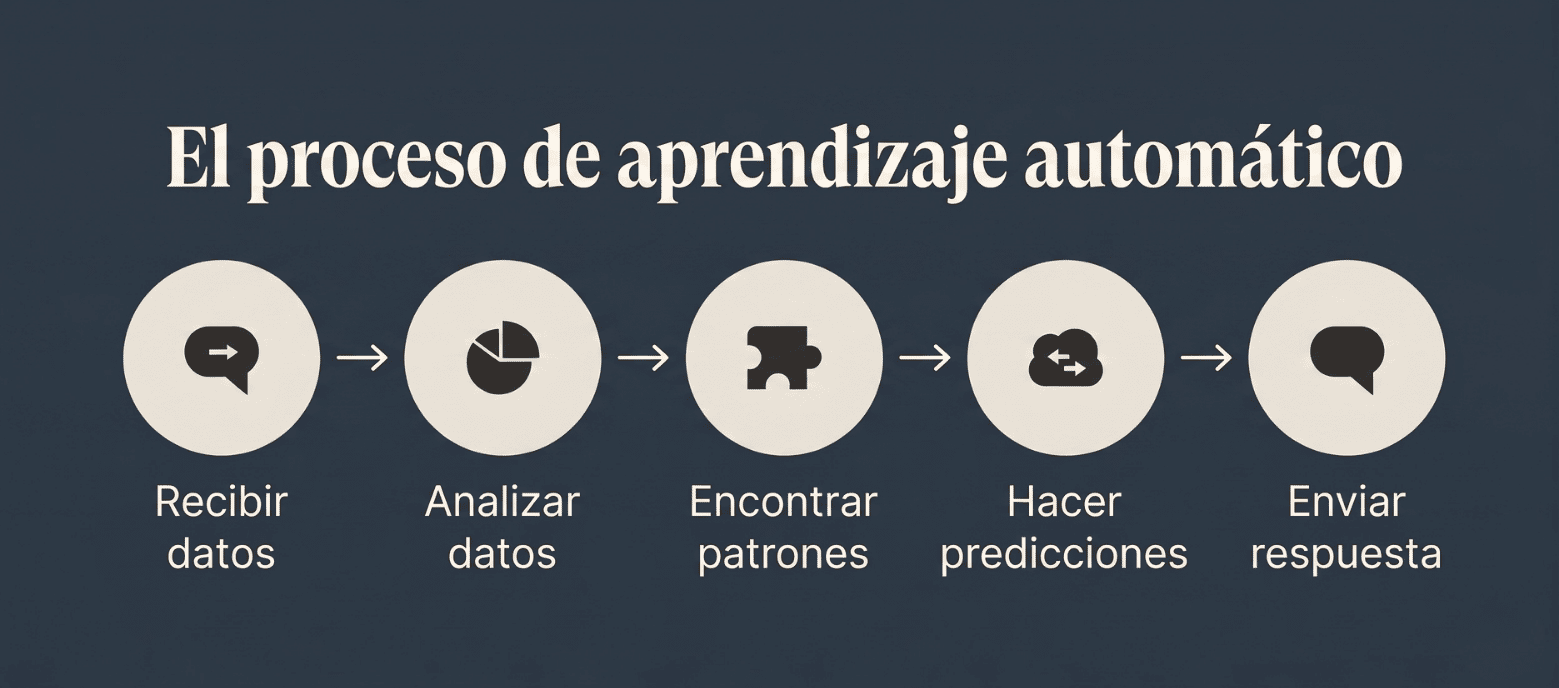
Para que el machine learning sea preciso, depende de ingenieros humanos que le alimenten datos relevantes y preprocesados. Con asistencia humana, el ML es experto en resolver problemas complejos y generar insights importantes al identificar patrones en los datos. Una vez que un equipo entrena y optimiza el rendimiento de un modelo de ML, seguirá un proceso estándar:
Recibir nueva información a través de una consulta del usuario.
Analizar los datos.
Encontrar un patrón.
Hacer una predicción.
Enviar una respuesta de vuelta al usuario.
Este proceso se repite para cada consulta, y la diferencia principal entre los modelos de machine learning es cómo los entrenas. Además, hay tres tipos comunes de aprendizaje de modelos de ML:
Aprendizaje supervisado: A un algoritmo de machine learning se le proporcionan datos de entrenamiento etiquetados y aprende un modelo para responder a los datos.
Aprendizaje no supervisado: Las herramientas de IA son alimentadas con datos sin etiquetar e identifican patrones sin intervención humana.
Aprendizaje por refuerzo: Los modelos de ML son alimentados con datos de entrenamiento y usan prueba y error y retroalimentación para aprender.
El mejor tipo de aprendizaje depende de las necesidades y expectativas de cada usuario, especialmente si se espera que un modelo de ML soporte la automatización inteligente.
Un ejemplo de machine learning:
Los servicios de streaming de música y video—como Spotify, Apple Music y YouTube—usan machine learning y aprendizaje por refuerzo para impulsar recomendaciones bajo demanda. Los algoritmos de ML asocian las preferencias del oyente (por ejemplo, canciones guardadas, listas de reproducción, creadores seguidos y videos favoritos) con artistas, álbumes, creadores y otros con gustos similares.
¿Qué es el deep learning?
El deep learning es un subconjunto del machine learning que usa una red neuronal artificial para aprender autónomamente, tomar decisiones inteligentes y determinar la precisión de las predicciones sin intervención humana. Debido a que los modelos de deep learning analizan datos continuamente, construyen conocimiento extenso con el tiempo y sacan conclusiones al recibir información, consultar reservas de datos y determinar una respuesta.
Las aplicaciones de deep learning usan una estructura en capas de algoritmos—también conocidas como redes neuronales—para recibir datos sin etiquetar (la entrada), identificar patrones y desarrollar una respuesta final (la salida). Hay varios tipos de redes neuronales, incluyendo:
Redes neuronales feedforward (FF o FFNN): Una red artificial donde la información fluye en una dirección—desde nodos de entrada hasta nodos de salida. Esta es la forma más simple de deep learning y no incluye ciclos o bucles.
Redes neuronales recurrentes (RNN): Algoritmos de IA que usan bucles de retroalimentación incorporados para "recordar" puntos de datos pasados. Las RNN pueden usar esta memoria de eventos pasados para informar su comprensión de eventos actuales o incluso predecir el futuro.
Memoria a largo/corto plazo (LSTM): Una red neuronal recurrente especializada diseñada para aprender y recordar dependencias a largo plazo en datos secuenciales. Estas redes son particularmente efectivas para tareas donde el contexto de entradas anteriores es crucial.
Redes neuronales convolucionales (CNN): Algoritmos que a menudo impulsan la visión por computadora y el reconocimiento de imágenes. Estas redes filtran prompts visuales al evaluar patrones, texturas, formas, colores y otros componentes.
Redes generativas adversarias (GAN): Una arquitectura de deep learning que consiste en dos redes—un generador que crea datos sintéticos y un discriminador que distingue datos reales y falsos.
Perceptrones multicapa (MLP): Redes neuronales feedforward compuestas de múltiples capas de perceptrones, haciéndolas capaces de aprender patrones complejos y resolver problemas no lineales en varios dominios.
Debido a estas redes neuronales, el deep learning tiende a ser más avanzado que los modelos estándar de machine learning.
Un ejemplo de deep learning:
Los agentes de IA de Zendesk usan deep learning para categorizar automáticamente tickets de soporte, predecir el sentimiento del cliente y resolver consultas de clientes. Para estos bots autónomos, los mensajes de clientes son la entrada, la urgencia y complejidad del mensaje se analizan dentro de la red neuronal, y la ruta del ticket y el tiempo de resolución predicho son la salida.
Preguntas frecuentes
Una red neuronal—también llamada red neuronal artificial (ANN)—es un modelo de machine learning que imita la estructura del cerebro. Estas redes funcionan al recibir información a través de una entrada, permitiendo que esa información fluya entre nodos y capas ocultas, usando un algoritmo para analizar y aprender de esa entrada, y enviando de vuelta una respuesta final a través de la capa de salida.
El DL y el ML son ramas similares de IA. Ambos buscan permitir que las computadoras aprendan de datos sin intervención humana. Estas similitudes incluyen:
Algoritmos entrenados que reconocen patrones
Conjuntos de datos de entrenamiento usados para construir modelos predictivos
Modelos que usan procesos de aprendizaje iterativos
Técnicas estadísticas para extraer insights de datos
Un ejemplo clásico de machine learning que no es deep learning es un algoritmo aleatorio usado para evaluación de riesgo crediticio en banca. Al analizar datos financieros históricos, como ingresos, puntaje de crédito, historial laboral y rendimiento de préstamos previos, este algoritmo de ML puede usar un modelo predictivo para pronosticar la probabilidad de que un solicitante de préstamo incumpla. Esto requeriría ingeniería de características (e intervención humana) y modelos computacionales simples.
Una red neuronal convolucional es un tipo de algoritmo de deep learning. Debido a que las CNN son un subconjunto de redes neuronales que utilizan DL, son parte de la arquitectura de deep learning en lugar del enfoque más simple de machine learning.
Asistencia a agentes: Las herramientas potenciadas por IA como el copiloto de IA, el procesamiento de lenguaje natural (NLP) y el aprendizaje continuo hacen posible que la IA agilice el soporte al cliente y empodere a los agentes con insights.
Chatbots de servicio al cliente: Los bots conversacionales pueden usar ML y DL para personalizar respuestas, recopilar datos de clientes y responder preguntas de clientes sin participación humana.
Automatización de flujos de trabajo: El ML y el DL pueden optimizar flujos de trabajo al enrutar inteligentemente solicitudes al agente correcto y sugerir automáticamente respuestas preescritas a preguntas de clientes.
Analítica predictiva: Usando datos históricos y capacidades de machine learning, la analítica predictiva ayuda a los equipos a pronosticar qué sucederá en el futuro para ayudar a los equipos a anticipar problemas de clientes.
Detección de fraude: El deep learning y el machine learning pueden ayudar a los equipos de soporte al señalar proactivamente problemas de seguridad como una contraseña insegura o un inicio de sesión sospechoso.
Todas estas herramientas son beneficiosas para los equipos de servicio al cliente y pueden impactar positivamente el rendimiento de agentes.
Ofrece una CX fluida con IA inteligente
Según Zendesk Benchmark Data, el 71 por ciento de los clientes cree que la IA mejora la calidad del servicio que reciben—y esperan ver más IA en el servicio al cliente en el futuro. La diferencia entre deep learning y machine learning importa ya que sus usos combinados continuarán impulsando ahorros de tiempo, recursos y costos.
Afortunadamente, Zendesk AI es una solución de IA poderosa con una baja barrera de entrada. Nuestra solución de IA puede manejar incluso las interacciones de clientes más complejas al priorizar la IA en CX y usar miles de millones de puntos de datos de servicio al cliente como la base de su entrenamiento. No esperes: llena tus brechas de conocimiento y ayuda a los agentes a alcanzar nuevos niveles de productividad con nuestra solución potenciada por IA hoy.
Candace Marshall
Vicepresidente de Marketing de Productos, IA y Automatización
Candace Marshall es una líder experimentada de product marketing con pasión por resolver problemas complejos e impulsar innovación en entornos de alto ritmo. Su carrera comenzó en operaciones e investigación, pero su interés por entender a los clientes y convertir insights en estrategias de impacto la llevó a product marketing. Actualmente, Candace lidera el product marketing de Zendesk AI, incluyendo AI agents y Copilot, impulsando crecimiento en soluciones con IA y en la oferta core de service. Su equipo entrega estrategias end-to-end, desde validación de mercado y messaging hasta ejecución de go-to-market y adopción. Antes de Zendesk, Candace pasó casi una década en LinkedIn, donde construyó y lideró el equipo de product marketing de la división Marketing Solutions, supervisando productos clave de publicidad en un negocio de varios miles de millones de dólares.
Aprovecha la IA para transformar el servicio al cliente
Aprende cómo mejorar el autoservicio, los flujos de trabajo y la productividad con una demo.