Top 7 AI agent tools for e-commerce in 2026
Compare AI agents for guided selling and service automation to help improve CSAT, AOV, and agent productivity.



Candace Marshall
Vice President of Product, AI and Automation at Zendesk
Última actualización en June 3, 2026
What are AI agent tools for e-commerce?
AI agent tools for e-commerce are systems that understand shopper intent, consider product, customer, and order context, and take action across the shopping and support journey. They can guide shoppers during browsing and checkout or automate high-volume requests like order status, returns, and refunds. For CX and EX teams, they improve shopper experiences while reducing repetitive work for support teams.
Why AI agents are a priority
Customers increasingly expect fast, real-time support. According to the Zendesk CX Trends Report 2026, 74 percent of consumers say AI has made them expect 24/7 customer service, and 85 percent of CX leaders say customers will leave brands that can’t resolve issues on first contact.
E-commerce teams face seasonal spikes in high-volume requests like order updates, returns, and refunds. AI agents provide a solution to this increased support demand, improving speed, cost, and service quality when grounded in trusted knowledge and connected to customer, product, and order data. This means faster, more accurate answers for shoppers and less repetitive work, burnout, and context switching for agents.
In this guide, we'll explore the best AI agent tools for e-commerce, helping you choose the right fit for your business.
More in this guide:
- AI agent tools for e-commerce comparison chart
- 7 best agentic AI agent tools for e-commerce
- How to choose the right AI agent for your e-commerce business
- Key features to evaluate in AI agents for e-commerce
- Frequently asked questions
- Deliver better e-commerce support with Zendesk
AI agent tools for e-commerce comparison chart
Compare the top AI agent tools for e-commerce. This chart can help you quickly narrow options based on their use case, pricing, and trial availability.
|
Software |
Best for |
Starting price |
Free trial |
|
Zendesk AI |
Complete, AI-powered e-commerce customer service |
$55 per agent/month (billed annually) |
14 days |
|
Forethought AI Agents by Zendesk |
Extending agentic AI across existing support workflows |
Custom pricing |
Unavailable |
|
Fin by Intercom |
Teams prioritizing simplicity over operational depth |
$29 per seat/month |
14 days |
|
Yuma AI |
Basic e-commerce ticket automation |
Custom pricing |
30 days |
|
Ada CX |
Standalone AI automation use cases |
Custom pricing |
14 days |
|
Gorgias |
Shopify-focused support automation |
$10 per agent/month (50 tickets) |
7 days |
|
Zowie |
Basic e-commerce chatbot automation |
Custom pricing |
Unavailable |
7 best agentic AI agent tools for e-commerce
The top AI agent tools for e-commerce resolve high-volume customer requests, support shoppers across channels, and connect with systems that hold order, product, and customer data. The best fit depends on your support stack, automation goals, and how much control your team needs over workflows, quality, and handoffs.
- Zendesk AI: Best for complete, AI-powered e-commerce customer service
- Forethought AI Agents by Zendesk: Best for extending agentic AI across existing support workflows
- Fin by Intercom: Best for teams prioritizing simplicity over operational depth
- Yuma AI: Best for basic e-commerce ticket automation
- Ada CX: Best for standalone AI automation use cases
- Gorgias: Best for Shopify-focused support automation
- Zowie: Best for basic e-commerce chatbot automation
1. Zendesk AI
Best for complete, AI-powered e-commerce customer service
| Starting price | Free trial | Key features |
|
$55 per agent/month billed annually Explore more Zendesk pricing plans. | 14 days |
|
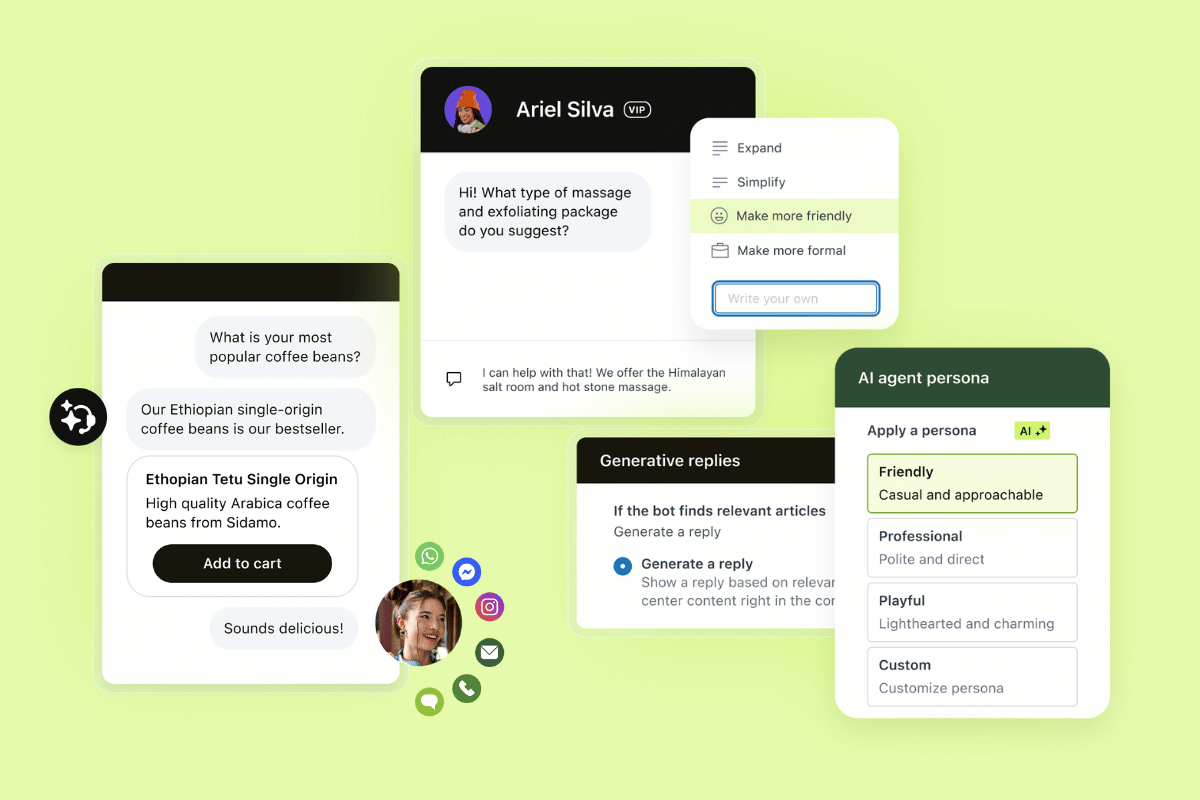
Zendesk AI is the best fit for e-commerce teams that want more than a standalone automation tool. It brings Zendesk AI agents, AI Copilot, knowledge, QA, analytics, and human handoff into one customer service platform—so teams can automate support without disconnecting the customer journey. Zendesk AI agents can automate tasks, customize chatbot behavior, surface performance insights, and route unresolved issues to the right team with full context.
For e-commerce, a connected approach is critical. Zendesk AI agents use adaptive reasoning to understand requests, ask follow-up questions, and respond based on context. They can also take actions across business systems, which means they support more complex issues like checking order status, updating delivery details, or managing subscription changes—not just answering FAQs. Paired with knowledge-powered generative replies and natural language procedures, Zendesk gives teams a faster way to automate common workflows without building rigid, one-off bot flows.
Zendesk also stands out because it supports the full service operation. AI Copilot gives agents context and suggests next steps in real time. Native QA for AI agents helps teams monitor interaction quality, while brand voice and persona customization keep automated responses consistent with the business’s tone. With omnichannel and multilingual support, Zendesk can scale AI for e-commerce across channels, regions, and customer needs while keeping human agents focused on higher-value work.
| Pros | Cons |
|
|
What people are saying:
- “I still really appreciate having cross channel support with email, calls, and chats all in one central platform. One thing I’ve continued to value is how easy it is to review a customer’s full ticket history, which helps provide better context and continuity when assisting them.” - Verified user, G2 review.
- “One of the things I like about Zendesk is how efficiently it manages customer queries through a centralized ticketing system. It allows support teams to track, prioritize, and resolve customer issues in an organized way, which improves overall response time and service quality.” - Verified user, G2 review.
- “I also enjoy the fact that Zendesk AI is able to propose answers to agents on similar tickets that have been previously dealt with.” - Verified user, G2 review.
2. Forethought AI Agents by Zendesk
Best for extending agentic AI across existing support workflows
|
Starting price |
Free trial |
Key features |
|
Custom pricing |
Unavailable |
|
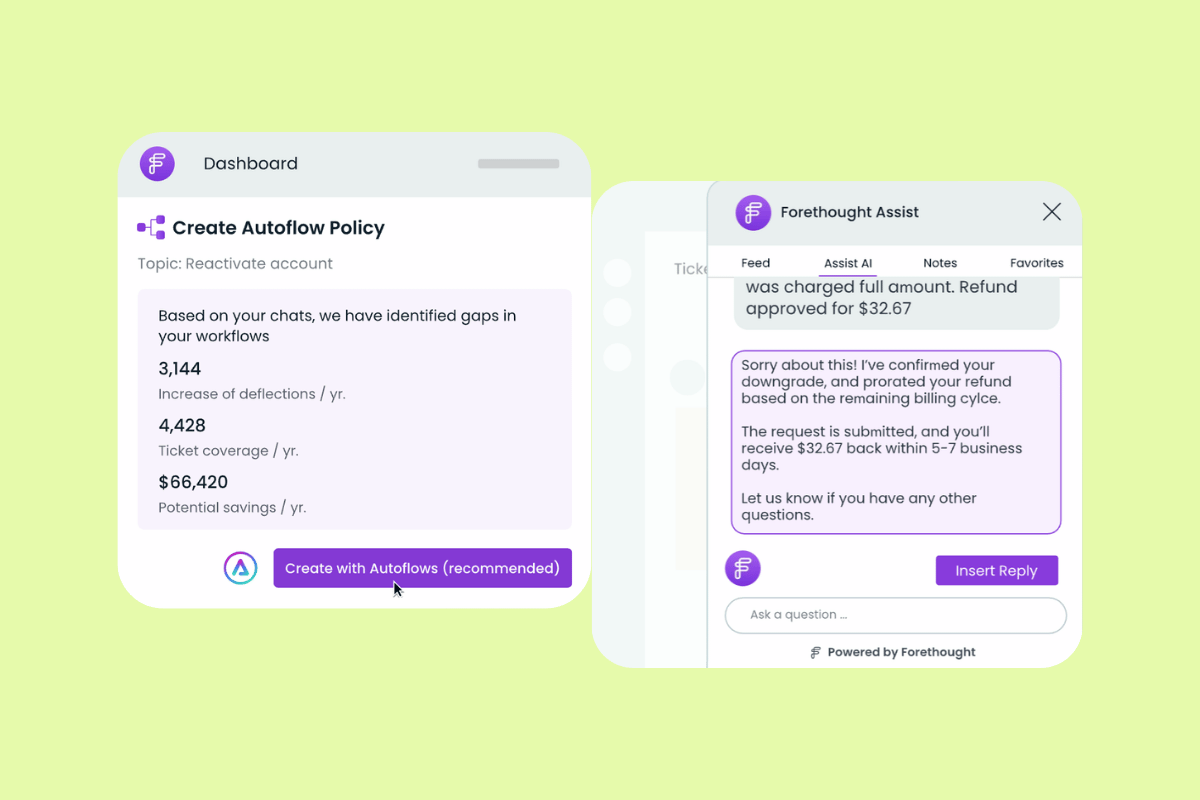
Forethought by Zendesk is a customer support AI platform focused on automating digital service workflows. The platform uses a multi-agent system trained on past tickets and help center content to understand intent, resolve inquiries, classify tickets, and support agents across the customer journey. Forethought is now part of Zendesk and will extend self-improving AI agent capabilities across chat, email, and voice.
Forethought’s capabilities include automated issue resolution, ticket classification and prioritization, omnichannel support across digital channels, and integrations with help desk, knowledge base, CRM, and API systems. G2 reviewers frequently mention workflow streamlining, faster response times, the intuitive interface, responsive support, and strong AI performance signals. These features make Forethought a fit for AI-first digital support teams looking to add automation to existing service operations rather than replace their full support platform.
|
Pros |
Cons |
|
|
What people are saying:
- “Overall, Forethought has become an indispensable tool for enhancing efficiency and improving the client experience” - Verified user, G2 review.
- “The most capable Support focused AI solution we have tried with high quality built in analytics and impact forecasting/reporting as well.” - Verified user, G2 review.
- “Custom reporting would be a real game-changer for us!” - Verified user, G2 review.
Learn more: Read all about how Forethought is now part of Zendesk.
3. Fin by Intercom
Best for teams prioritizing simplicity over operational depth
|
Starting price |
Free trial |
Key features |
|
$29 per seat/month |
14 days |
|
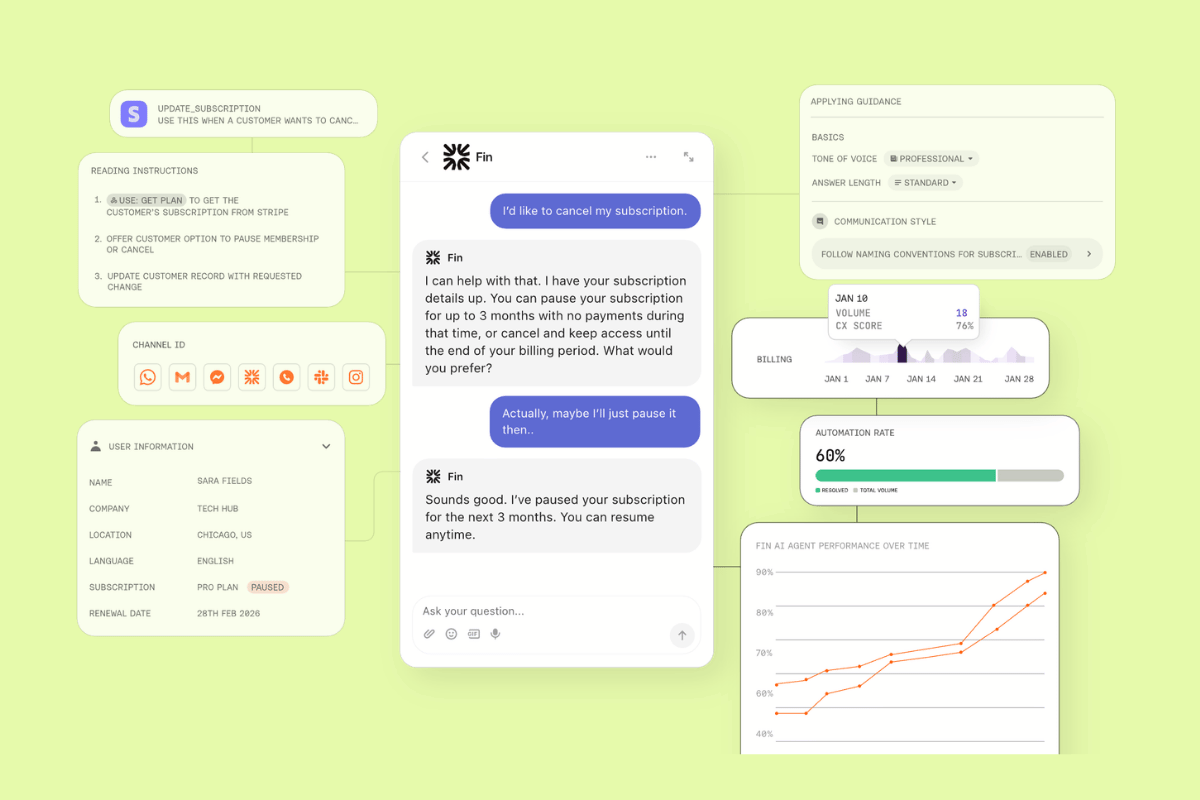
Intercom is a customer service platform with a helpdesk, shared inbox, AI agent, and agent-assist tools. Its AI agent, Fin, is built into the Intercom helpdesk, so support teams and AI can work from the same inbox with shared customer context. This makes Intercom a fit for teams that don’t need the broader QA, workforce management, and service operations depth of a unified platform like Zendesk.
Intercom’s AI capabilities center on Fin, Copilot, and Workflows. The platform also offers Fin for Ecommerce, a Shopify-native AI agent role designed to support product discovery and reduce buying friction. Users like the fast automation for routine digital support, but they note some limits with nuance, visibility, and cost.
|
Pros |
Cons |
|
|
What people are saying:
- “What I like most about Fin is how effectively it automates customer support by providing fast, relevant answers based on existing knowledge base content.” - Verified user, G2 review.
- “What I dislike most about Fin by Intercom is that, while powerful, it can feel restrictive and costly depending on your team’s needs and scale. Fin’s cost per resolved conversation can become expensive for high-volume support teams, making ROI harder to justify without careful monitoring.” - Verified user, G2 review.
- “The system seems very cost prohibitive, especially for smaller businesses, and didn't work as well, which is why we ended up choosing another provider that was a little more affordable.” - Verified user, G2 review.
Learn more: Discover how Intercom integrates with Zendesk and how Zendesk vs. Intercom compare.
4. Yuma AI
Best for basic e-commerce ticket automation
|
Starting price |
Free trial |
Key features |
|
Custom pricing |
30 days |
|
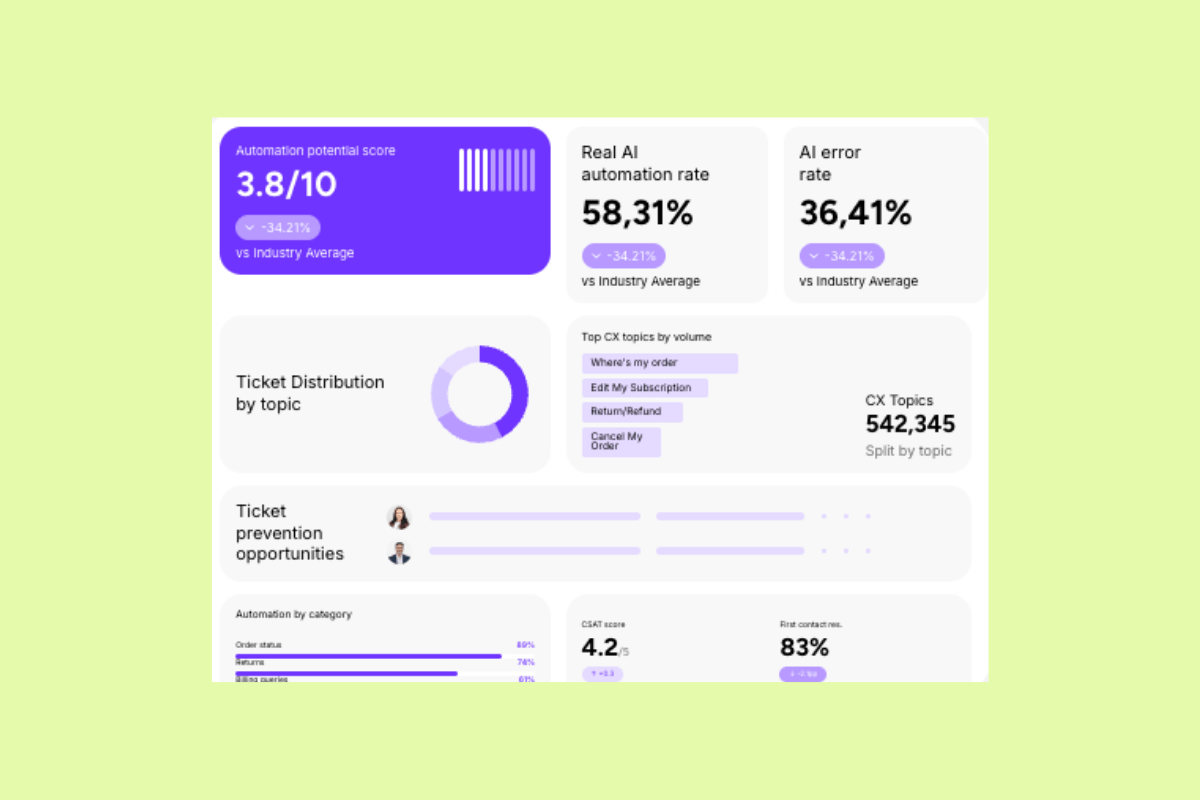
Yuma AI is an AI platform built for e-commerce brands that want to automate routine customer support. Its support AI focuses on common ticket types like order updates, returns, refunds, shipping questions, and repetitive post-purchase requests. This makes it a fit for businesses seeking basic e-commerce ticket automation.
Yuma also offers AI chat, social media automation, sales AI, and a customer knowledge base for online stores. Teams can deploy across channels with no engineering work and use AI to process returns and refunds, assist human agents, and hand off complex conversations with context. G2 reviewers praise Yuma AI for its ease of use and automation capabilities. Still, some highlight inaccuracies that require manual review.
|
Pros |
Cons |
|
|
What people are saying:
- “The initial setup was very easy, and these features help streamline our automation tasks significantly.” - Verified user, G2 review.
- “Sometimes it hallucinates and the process gets off track but the team solves it eventually” -Verified user, G2 review.
- “AI is powerful but isn't magic. We still need to spend some time to monitor, improve the prompt, etc. to make sure the tool is more and more relevant.” - Verified user, G2 review.
5. Ada CX
Best for standalone AI automation use cases
|
Starting price |
Free trial |
Key features |
|
Custom pricing |
14 days |
|
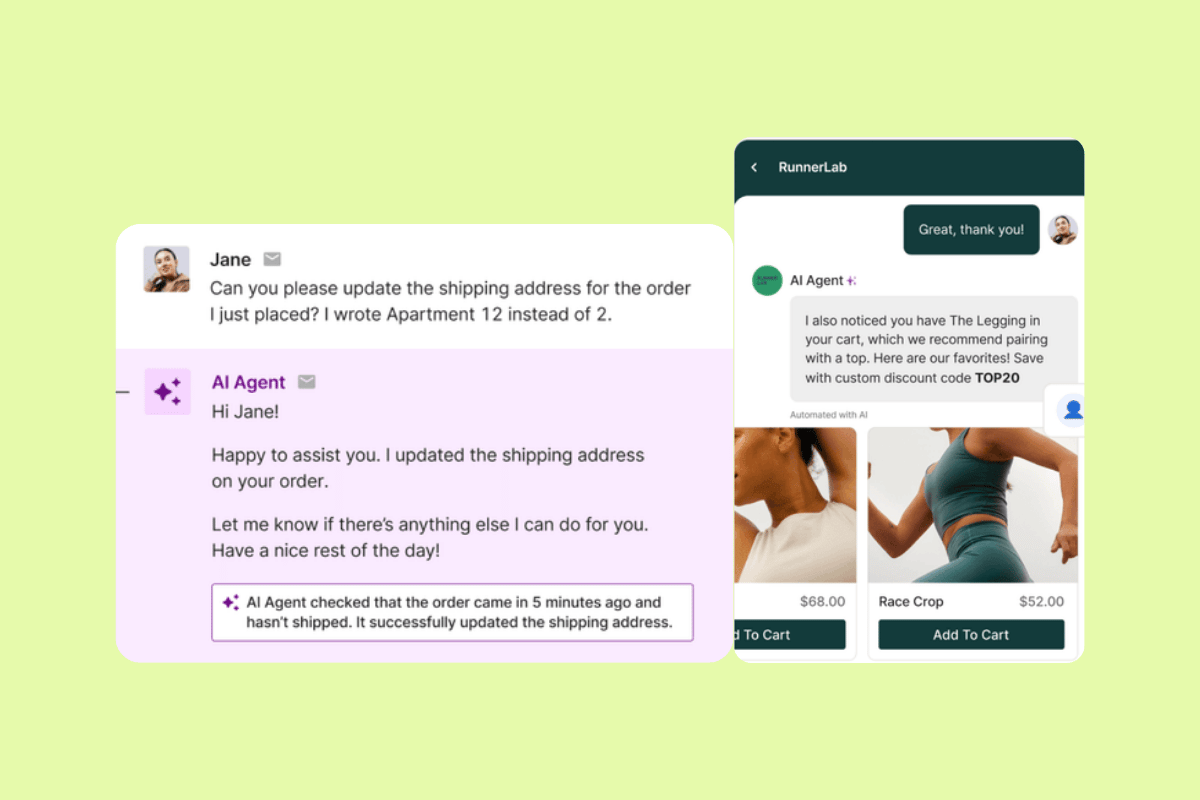
Ada is an AI customer service platform for building, deploying, and optimizing AI agents. It focuses on standalone AI automation use cases across chat, email, voice, SMS, and social channels, making it a fit for teams that want targeted automation rather than a broader out-of-the-box CX platform.
Ada’s capabilities include AI voice agents, messaging support, email automation, human handoff, API-driven actions, coaching, and enterprise security and compliance. Users often praise its automation and ease of use, while common drawbacks point to more manual setup and limits in dynamic workflow logic. Teams looking for targeted AI automation may find it a strong fit.
|
Pros |
Cons |
|
|
What people are saying:
- “The product is easy to use and delivers rapid results, enhancing our operational efficiency.” - Verified user, G2 review.
- “While Ada’s platform is powerful and user-friendly, it can feel a bit limited when it comes to building more dynamic workflows or adapting the conversation logic automatically based on user intent.” - Verified user, G2 review.
- “The setup process for flows sometimes requires more manual work and testing than expected, especially when compared to platforms that offer stronger built-in discovery features or self-optimizing flows.” - Verified user, G2 review.
Learn more: Discover how Ada integrates with Zendesk.
6. Gorgias
Best for Shopify-focused support automation
|
Starting price |
Free trial |
Key features |
|
$10 per agent/month (50 tickets) |
7 days |
|
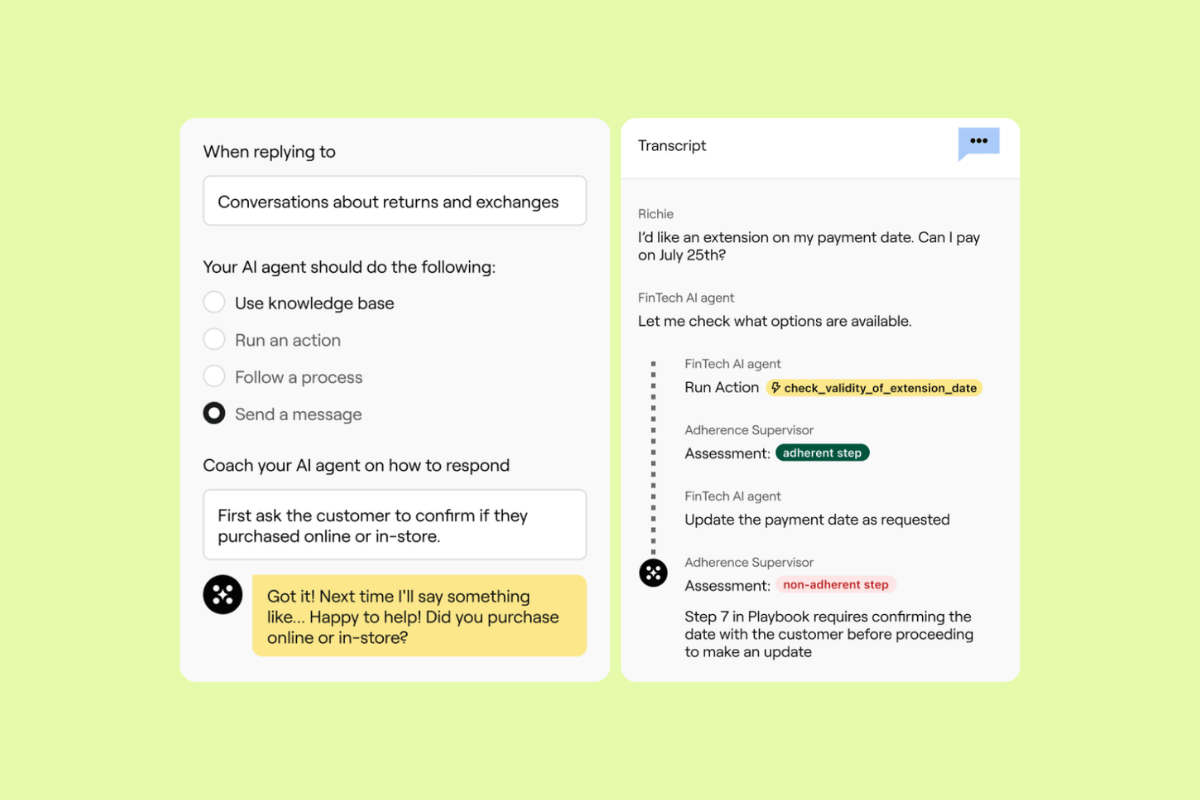
Gorgias is an AI-powered helpdesk and conversational AI platform built for e-commerce brands. It focuses on support and sales, with an AI Agent, helpdesk, chat, FAQ tools, and integrations that connect customer conversations to store data. This makes Gorgias a fit for Shopify-focused support automation, especially for teams that want to manage repetitive e-commerce inquiries from one support inbox.
Its capabilities are geared toward online retail workflows. Gorgias AI Agent can respond to customer emails, answer order-related questions, resolve tickets, and support shoppers with personalized product recommendations. Users often praise its ease of use and Shopify integration, while common drawbacks include limited reporting and some fine-tuning needed for advanced features.
|
Pros |
Cons |
|
|
What people are saying:
- “The platform itself is clear and easy to use” - Verified user, G2 review.
- “The reporting suite is super limited. It'd be good to be able to make custom queries.” - Verified user, G2 review.
- “[...] some of the more advanced automation and reporting features can take a bit of fine-tuning to get exactly right” - Verified user, G2 review.
Learn more: Discover how Gorgias integrates with Zendesk and how Zendesk vs. Gorgias compare.
7. Zowie
Best for basic e-commerce chatbot automation
|
Starting price |
Free trial |
Key features |
|
Custom pricing |
Not available |
|
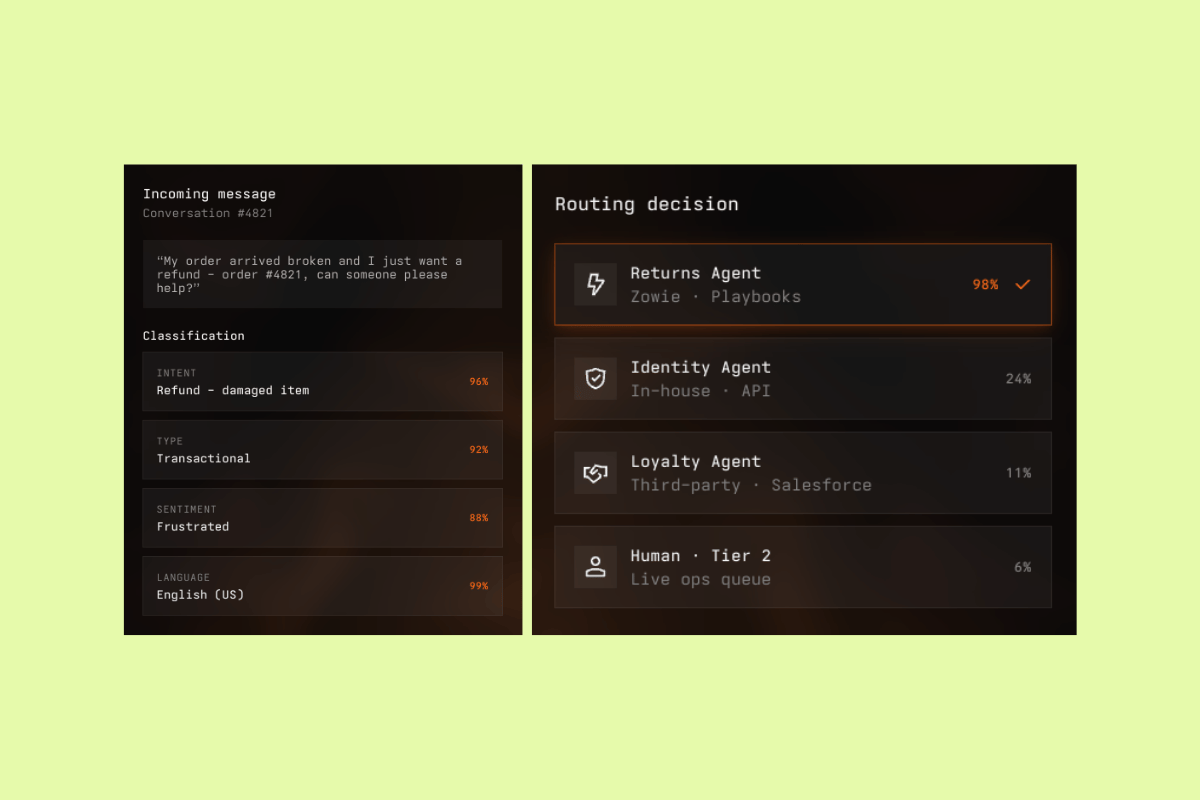
Zowie is an AI customer service platform that helps e-commerce teams automate customer interactions across chat, email, voice, and social channels. Its AI Agent can identify customer intent, apply business rules, use integrations, and resolve requests like refunds, order changes, and sales conversations.
Zowie’s capabilities include AI chat, help desk integrations, system integrations, business rules, AI coaching, and performance monitoring. It connects with tools like Shopify, Zendesk, and custom systems. This makes Zowie a fit for basic e-commerce chatbot automation, especially for teams that want to automate common online retail requests without rebuilding their existing stack. Users praise Zowie's ease of use and efficient automation, but complain about its limited features and lack of reporting capabilities.
|
Pros |
Cons |
|
|
What people are saying:
- “Zowie works really fast and it's technically well prepared. The software is very intuitive and easy in use.” - Verified user, G2 review.
- “Lack of next level customization for small startups.” - Verified user, G2 review.
- “What should be more developed is the reporting module. I find it lacking in terms of integration with BI tools or advanced reporting for managing chatbots for multiple brands across various markets.” - Verified user, G2 review.
How to choose the right AI agent for your e-commerce business
This framework helps you choose an AI agent based on the problems you need to solve first. The goal isn’t to automate everything at once—it’s to reduce the most expensive, repetitive, or operationally painful work, like order status requests, returns, refunds, and delivery updates. Prioritize tools that fit your existing processes, connect with key systems, and show measurable impact over platforms with the longest feature list.
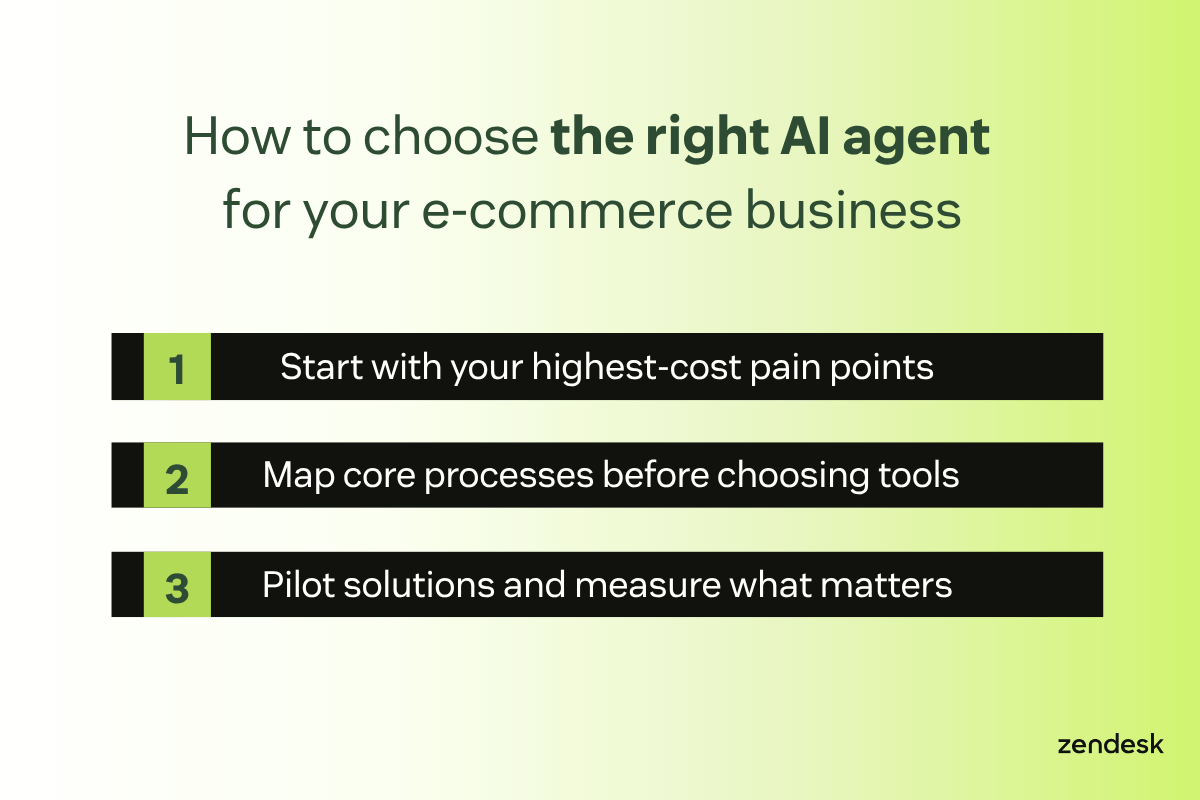
Start with your highest-cost pain points
Start by identifying where AI agents can create the fastest measurable impact. For many e-commerce teams, this means high-volume support tickets, repetitive customer questions, content generation, or inventory-related issues that slow down agents and frustrate shoppers. Prioritize workflows with clear cost or CX impact before expanding into more complex automation.
Map core processes before choosing tools
Map your core e-commerce workflows before comparing tools. This can include order management, returns, product discovery, support escalation, and post-purchase follow-up. AI agents should align with these processes, not replace them blindly. So, focus on where automation can realistically improve speed, accuracy, or the customer experience.
Pilot solutions and measure what matters
Run small pilots before rolling out AI agents across your e-commerce operation. Test real use cases like order tracking, returns, refunds, product questions, and inventory updates, not just demos.
Additionally, measure resolution rates, cost per automation, and customer satisfaction (CSAT). Assess integrations with your e-commerce platform, CRM, inventory systems, and other core tools. Scale only where pilots prove the AI agent can reduce workload, improve accuracy, or create a better customer experience.
Key features to evaluate in AI agents for e-commerce
This checklist helps you evaluate AI agents beyond surface-level features. Keep in mind that the right tool should support your business goals and fit your day-to-day operations, from integrations and usability to time to value. Prioritize features that improve measurable outcomes like resolution speed, automation rate, cost per interaction, and customer satisfaction.
Omnichannel and customer interaction capabilities
AI agents for e-commerce should support customers across web, mobile apps, messaging, and social channels. Look for conversational quality, natural language processing (NLP)-based search, and the ability to handle both support and guided selling interactions. The goal is consistent service across every touchpoint, so shoppers don’t have to restart the conversation when they switch channels.
Transactional and workflow automation
Beyond just answering questions, strong AI agents are able to carry out live chat order actions like processing returns, updating orders, checking delivery status, or starting refunds. These capabilities are especially valuable for customer service automation because they reduce human intervention, speed up resolutions, and lower the cost of repetitive support.
Personalization and product intelligence
AI for e-commerce should use customer, product, and order data to make interactions more relevant. This can include personalized product recommendations, contextual support, and guided discovery during browsing or checkout. The best tools can also support upsell and cross-sell opportunities without making the experience feel disconnected from the customer’s intent.
Content generation and business insights
Evaluate whether the tool can generate useful content, such as customer responses, product descriptions, or support copy. Built-in reporting and analytics are just as important. Dashboards, customer behavior insights, and performance data can show where AI agents are working, where customers get stuck, and which workflows need improvement.
Integration, control, and time to value
AI agents should integrate with your e-commerce platform, CRM system, inventory tools, order management software, and support channels. You should also assess customization, vendor support, data privacy, compliance, and how quickly the tool delivers measurable value. Don’t rely on automation claims alone—look for proof that the solution can improve real workflows in your business.
Frequently asked questions
Deliver better e-commerce support with Zendesk
Zendesk gives e-commerce teams the AI tools they need to deliver fast, accurate, and consistent customer support. With AI agents, knowledge, QA, analytics, and human handoff built into one platform, teams can resolve more requests while keeping service quality high. For support agents, Zendesk reduces repetitive work, streamlines workflows, and preserves context when a customer needs to talk to a human. Start a free trial to see how Zendesk can improve your customer experience, employee experience, and support operations.
Candace Marshall
Vice President of Product, AI and Automation at Zendesk
Candace Marshall is a product marketing leader at Zendesk, where she heads AI product marketing across AI Agents, Copilot, and core service offerings. She is passionate about transforming customer insights into strategies that create real business impact, and her team delivers end-to-end go-to-market programs that bring Zendesk’s AI vision to life. Before Zendesk, Candace spent nearly a decade at LinkedIn, building and leading product marketing for its rapidly scaling Marketing Solutions division.
tierThree:share_the_story
Related guides on AI agent tools for e-commerce
Explore expert resources on selecting, deploying, and scaling AI agents in e-commerce, from guided selling and automation to integration, performance, and measurable business impact.